Content Editor, Dunham | 2025 ThinkAdvisor Luminaries Award Winner | 2026 Wealthies Finalist, Thought Leader of the Year | Macroeconomics, markets, geopolitics & global trends
AI data centers are becoming a major source of new electricity demand, especially in a handful of grid-constrained U.S. regions. That is raising questions about affordability, transmission and reliable supply. Nuclear power may help meet some of that demand, but construction timelines, fuel supply and permitting make it a long-term picture.
Key Takeaways:
AI is making data centers a major driver of new electricity demand, with the sharpest pressure falling on already-constrained regional grids.
Globally, data-center electricity use could more than double to roughly 945 TWh by 2030; U.S. data centers could account for 11.8% of total U.S. electricity use by then.
The immediate bottleneck is not simply generating more power. It is building transmission, substations, interconnection capacity and dependable generation quickly enough.
Nuclear offers always-available, low-carbon power that fits data centers’ needs, but new reactors and SMRs remain a longer-term part of the supply response.
The AI buildout may create opportunities across power generation, grid equipment and nuclear fuel—but also capital-cycle risks if investment outruns durable demand.
Once a boring corner of tech - hosting servers and storage systems no one cared about - data centers are now driving the economy.
What was once niche infrastructure is now the industrial engine of the digital age - some even call it the fourth industrial revolution - powered by an AI and cloud boom spreading like a virus (no pun intended. Okay, maybe a little intended).
We’ve all seen the headlines - “AI Is Taking Over the World,” and “These 3 AI Stocks You Must Buy Now,” and “How AI Will Cause Surging Unemployment.”
Sure, it’s noisy. Maybe overhyped.
But here’s the thing – whether we agree or not, there’s truth behind the hype.
How Big Is AI Data Center Energy Demand?
Did you know that global data volumes are doubling every two years?
Meanwhile, here are some other stats that really emphasize this rapid growth.
As all these trillions of dollars flow into the AI and digital space, it will inevitably lead to diminishing returns where each new dollar produces less growth or returns.
Think of diminshing returns likeeating pizza - the first slice is amazing, the second still hits the spot. But by the fifth or sixth? You're full, and pushing for more just makes you queasy. That’s the risk with overinvesting - what starts as a sweet opportunity can quickly lead to saturation, waste, and discomfort.
This is why these kinds of booms often sow the seeds of their own busts.
And while this is an issue, it’s still likely years away.
For now, a more pressing thing is that these data centers are energyhogs. They need electricity not just for computing, but for cooling, security, networking, and backup systems.
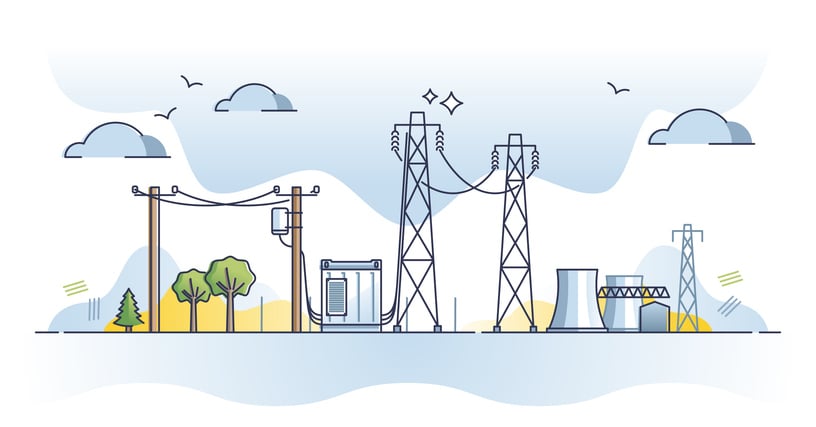
And all this AI-fueled infrastructure is straining real-world systems - especially the power grid.
In parts of the U.S., data centers now consume 10–15% of total electricity, pushing grid demand to 20-year highs.
In Northern Virginia - the epicenter of U.S. data centers - these facilities pull 15% of total grid power and are expected to push peak demand 32% beyond today’s capacity within 15 years.
This is worrying as now average Americans are effectively subsidizing Big Tech.
More AI energy demand = higher energy costs = higher bills for everyone.
Meeting this demand will require massive upgrades to the U.S. power system. Things like transmission lines, new generation, substations, and zoning reform.
Because of this, utilities are scrambling and regulators are asking whether deregulated markets can even scale fast enough.
And let’s not ignore the emissions problem – with most U.S. data centers still running on natural gas and coal. That’s a tough pill to swallow amid climate concerns.
Why Nuclear Power and Uranium Are Benefiting From the AI Boom
You might be thinking: “Okay, the AI boom is real. The power grid is strained. But what’s the clean, scalable fuel source to support it all?”
Exactly my thoughts.
Instead of focusing on what is already being talked about, it might make more sense to look at what could benefit from all this before it gets over crowded.
That’s why – I believe - the ripple effects of this AI boom and climate caution give nuclear energy a renaissance.
As the need grows for carbon-free, 24/7 energy, uranium is making a comeback.
Unlike wind or solar, nuclear runs non-stop.
Small Modular Reactors (SMRs) are gaining regulatory traction.
Tech giants like Amazon, Google, and Meta are already exploring nuclear-backed energy deals.
Uranium itself is trading at roughly $80 per pound as of yesterday.
Figure 4: Trading Economics, June 27th 2025
Of course, more mining = more supply = potential price pressure (yep, the capital cycle again). But that’s likely some time away.
What Investors Should Watch: Nuclear, Uranium, and the Energy Transition
We’re no longer just in a tech boom. We’re in a power boom. An infrastructure boom. A uranium boom.
As demand outpaces energy infrastructure, Big Tech’s ambitions are now colliding with the real-world constraints of grids, fuels, and regulation. And that means new winners - and risks - are emerging far beyond Silicon Valley.
The question isn’t whether this boom is real. It’s whether it can sustain itself without overheating. Because like every capital cycle, the seeds of saturation are already being sown.
For now, the data center and AI boom is running. But energy may be the new gatekeeper.
As always, I’ll keep you posted.
Enjoy your weekend.
FAQ
How much electricity will AI data centers use by 2030? Global data-center electricity consumption could more than double to about 945 TWh by 2030, according to the IEA. In the United States, data centers could account for 11.8% of total electricity use by 2030, although the outcome depends on AI adoption, equipment efficiency and the pace of construction.
Are AI data centers raising household electricity bills? They can raise costs in regions where new data-center demand tightens power supply or requires major grid upgrades. The effect on a household bill depends on local utility rules, how new infrastructure costs are allocated and whether large users pay a greater share of the expansion.
Can nuclear power meet AI data-center power demand? Nuclear can provide reliable, around-the-clock, low-carbon electricity that fits large data centers’ needs. But new nuclear projects take years to license and build, so nuclear is more likely to be part of the longer-term solution than an immediate answer to today’s grid constraints.
Why are power grids becoming a bottleneck for AI? Data centers require large amounts of electricity in concentrated locations. New transmission lines, substations, transformers and generation often take longer to build than the data centers themselves, creating local connection delays and capacity constraints.
Will small modular reactors power AI data centers? SMRs could eventually offer flexible, firm power near large industrial loads, including data centers. However, commercial deployment remains early; the IEA expects the first SMRs to come online around 2030.
This communication is general in nature and provided for educational and informational purposes only. It should not be considered or relied upon as legal, tax or investment advice or an investment recommendation, or as a substitute for legal or tax counsel. Any investment products or services named herein are for illustrative purposes only and should not be considered an offer to buy or sell, or an investment recommendation for, any specific security, strategy or investment product or service. Always consult a qualified professional or your own independent financial professional for personalized advice or investment recommendations tailored to your specific goals, individual situation, and risk tolerance. All examples are hypothetical and are for illustrative purposes only.
Information contained in the materials included is believed to be from reliable sources, but no representations or guarantees are made as to the accuracy or completeness of information. This document is provided for information purposes only and should not be considered as investment advice.
Dunham & Associates Investment Counsel, Inc. is a Registered Investment Adviser and Broker/Dealer. Member FINRA/SIPC. Advisory services and securities offered through Dunham & Associates Investment Counsel, Inc.
The AI Energy Crisis: Why Nuclear Power Is Making a Comeback | Dunham