Content Editor, Dunham | 2025 ThinkAdvisor Luminaries Award Winner | 2026 Wealthies Finalist, Thought Leader of the Year | Macroeconomics, markets, geopolitics & global trends
A global dollar shortage occurs when foreign countries, companies, and governments can't access enough U.S. dollars to repay dollar-denominated debt or fund international trade. Because the dollar is the world's reserve currency, a rising USD and higher U.S. interest rates tighten the global money supply — hitting emerging markets hardest.
Key Takeaways:
A dollar shortage occurs when countries can't access enough U.S. dollars to repay debt or fund trade.
The global financial system relies heavily on the dollar — and the U.S. supplies that liquidity by running trade deficits.
A rising dollar and higher U.S. interest rates make it harder for foreign borrowers to obtain and repay dollar-denominated debt.
Emerging markets face inflation, credit downgrades, and capital flight — amplifying economic risks globally.
The global dollar shortage is a growing structural threat with no easy solution — especially as debt servicing costs rise.
Listen to this blog here
8:27
What Is a Global Dollar Shortage?
Have you heard of the term “dollar shortage” or the "dollar gap"?
It refers to a scenario where foreign countries lack U.S. dollars in their reserves to conduct international trade effectively.
Simply put, a dollar shortage occurs when a country's USD outflows exceed its inflows. This can happen if it pays more dollars for imports than it earns from exports or has higher international dollar obligations (such as dollar debts).
And this is a big deal because the U.S. dollar is the global reserve currency – meaning the dollar’s status is a stable currency, making it widely used for pricing assets - and all countries and companies will accept dollars. After all, they know they can use those dollars to buy from anyone else.
But the key point here is that the global economy constantly needs dollars (the reserve currency). Thus the U.S. obliges by running huge trade deficits (aka exporting dollars), giving the world the dollars they need so that they import from each other, and international trade keeps humming along.
Figure 2: Dunham, 2024
Simple, right?
Well, this is where things get tricky. . .
Many institutions around the world have significant dollar-denominated debts.
Meaning a company or country issues “dollar bonds” – aka borrows in US dollars rather than their domestic currency (for example, Mexico may issue bonds denominated in U.S. dollars instead of the Peso because it’s more attractive to investors and less volatile).
Why is this a problem? Because the borrowing country – let’s keep using Mexico as an example here – must constantly get dollars to repay the dollar debts. And if they can’t export enough to bring in dollars, they have a higher risk of defaulting on their dollar loans.
Remember, these foreign borrowers can't conjure dollars out of thin air like the U.S. can.
And this is becoming a huge problem with so many nations loaded up with U.S. dollar debt. . .
The Rising Crisis of Dollar Debt
According to the International Monetary Fund1, there are roughly 70 countries (most frontier or emerging economies) at risk of debt distress - meaning they might default on their foreign loans. That’s more than a third of all countries in the entire world.
The numbers are staggering:
In 2021, developing nations paid $400 billion in debt servicing—double the amount they received in development aid.
Their international reserves fell by $600 billion that same year.
In fact, this debt issue has become so severe that the secretary-general of the United Nations Conference on Trade and Development - Rebeca Grynspan – called it one of “the biggest threats to global peace and security2.”
And this is why it’s called the globaldollar shortage.
Because many countries and corporations all around the world lack enough dollars to continue servicing their debts.
But here’s why it may get worse. . .
How Does Federal Reserve Policy Worsen a Dollar Shortage?
Federal Reserve monetary tightening can worsen a global dollar shortage by restricting offshore liquidity and driving up the value of the U.S. dollar. When the Fed hikes rates, it triggers capital flight toward U.S. assets, making dollars scarce and expensive abroad. While this acute squeeze intensified with recent rate hikes, the structural trend actually began building over a decade ago.
For instance, since the Federal Reserve began raising interest rates, the dollar has continued to get stronger relative to foreign currencies.
Remember, currencies are relative. Thus, for Currency A to rise, Currency B must see a decline (assuming only two currencies for simplicity).
But this trend really started back in 2014 when the Federal Reserve began tapering back its aggressive easing post-2008 and started talking about raising rates.
To put this into perspective, since summer 2014, the U.S. dollar index (the DXY) is up 25%.
Figure 3: Dunham, 2024
So why does this matter?
Because when the dollar gets stronger, it means the cost of those getting those dollars increases for foreign countries.
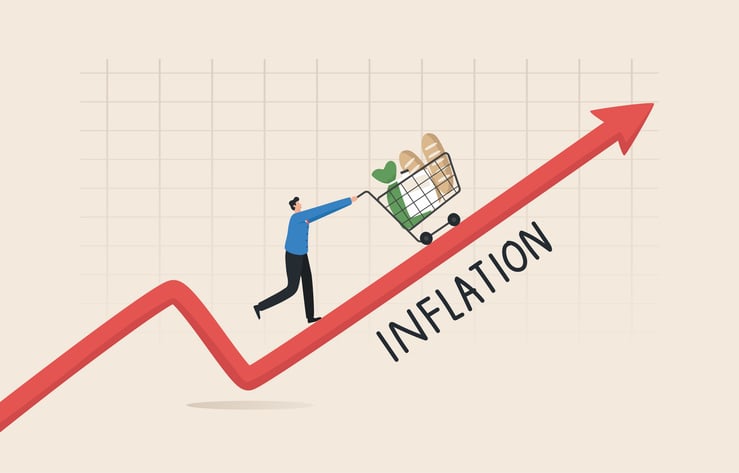
In fact, evidence shows that when a country’s currency weakens against the dollar, the cost of imports from the United States rises, putting upward pressure on prices. For instance, on average, a 10% dollar appreciation translates into a 1% increase in inflation abroad3.
Why? Well, since commodities - like oil, wheat, and metals - are priced in dollars, then a stronger dollar raises the costs of these goods.
Making matters worse, because food and energy expenditures constitute a larger share of consumption in emerging economies, increases in dollar-priced commodities significantly raise their cost of living.
Put simply, higher rates lead to:
Increased import costs for nations with weaker currencies.
Rising inflation, particularly in economies heavily reliant on dollar-priced commodities like oil and wheat.
Capital outflows, as investors pull money from riskier markets in favor of U.S. assets.
But this is particularly problematic for governments and companies in emerging economies, as most of their borrowing is in dollars (as I mentioned above).
A Worsening Problem for Emerging Economies
Here’s a quick history lesson: after the 2008 Global Financial Crisis, these emerging economies saw strong capital inflows after above-average growth and interest rates attracted investors (and money). Thus, as a result, borrowing in emerging economies grew, with over 80% of this debt denominated4 in foreign currency - primarily U.S. dollars.
So, countries or corporations that borrowed in U.S. dollars are now stuck dealing with an increased cost of getting those very dollars they need to pay back the debt.
Lovely, right?
Making matters worse, the pandemic caused a sharp reversal in capital flows as U.S. interest rates rose, leading to credit rating downgrades in many emerging economies.
Thus, those with high levels of external debt relative to foreign exchange (dollar) reserves experienced large-scale capital outflows and dramatic currency depreciations – amplifying the dollar shortage.
The Weaponized Dollar Shortage
A dollar drought doesn't just happen because of higher Federal Reserve rates or market cycles.
Washington can also engineer one.
How? Because global trade clears through American banks, the U.S. government controls the primary tollbooths for international finance. When Washington cuts off access, foreign economies suffocate quickly.
For example - look at Iran. Over the past decade, the U.S. Treasury used sanctions to cut Iranian banks off from international payment networks and target foreign firms handling Tehran's oil revenue.
This helped cause an acute shortage of dollars inside the country. And without access to dollars to settle foreign accounts, Iran’s rial plunged to record lows, domestic inflation surged, and companies struggled to pay for basic imports .
Thus, a reserve currency status is more than an economic advantage. It gives Washington the power to run a financial blockade without firing a single shot.
Final Thoughts: The Strong Dollar as a Wrecking Ball
The global dollar shortage – where foreign nations are struggling to get dollars to repay their liabilities and imports – seems to be getting worse.
Remember, an ever-growing amount of dollar debt globally means an ever larger amount of dollars needed to service it.
Thus, while many in the mainstream financial media talk about the dollar-debt problem, I believe it’s more important to discuss the servicing ability of that debt – aka the global dollar shortage.
The strong dollar is acting like a wrecking ball for emerging economies – crushing borrowing capacity, credit ratings, currencies, capital flows, and imports.
Things will likely keep getting worse for the global economy if this trend persists – which I believe it will.
Of course, if the Fed cuts interest rates, that may take some pressure off emerging markets and their currencies.
But the big question is: can many last until then?
As always, this is just some food for thought.
Frequently Asked Questions About the Global Dollar Shortage
What is a global dollar shortage? A global dollar shortage happens when foreign countries, companies, or governments can't get enough U.S. dollars to repay dollar debt or fund trade, meaning their dollar outflows exceed inflows. Since the dollar is the world's reserve currency, most countries end up needing dollars just to trade with each other, and a shortage makes that much harder to do.
Why does the U.S. dollar's reserve currency status cause a dollar shortage? The dollar makes up over 70% of global reserves, so nearly every country needs dollars to trade and pay debts. The U.S. supplies that liquidity by running trade deficits, essentially exporting dollars to the rest of the world. If the U.S. stopped buying more than it sells abroad, other countries would struggle to get the dollars they depend on.
How does the Fed raising interest rates make the dollar shortage worse? When the Fed raises interest rates, it pulls capital toward U.S. assets and pushes the dollar higher, making dollars scarcer and pricier abroad. A stronger dollar raises the cost of dollar-priced commodities like oil and wheat, and research shows a 10% dollar appreciation tends to push inflation abroad up by about 1%, according to Econofact.
Why are emerging markets hit hardest by a strong dollar? Emerging markets often borrow heavily in dollars rather than their own currency, with over 80% of emerging-market debt denominated in foreign currency, mostly dollars, according to the Financial Stability Board. When the dollar strengthens, repaying that debt gets more expensive, and countries face rising import costs, inflation, credit downgrades, and capital flight all at once.
How much dollar-denominated debt is at risk around the world? The IMF estimates roughly 70 countries, mostly frontier or emerging economies, face a risk of debt distress. In 2021 alone, developing nations paid $400 billion in debt servicing, double what they received in development aid, while their international reserves fell by $600 billion. The Bank for International Settlements also points to about $65 trillion in additional hidden dollar debt held outside the U.S.
This communication is general in nature and provided for educational and informational purposes only. It should not be considered or relied upon as legal, tax or investment advice or an investment recommendation, or as a substitute for legal or tax counsel. Any investment products or services named herein are for illustrative purposes only and should not be considered an offer to buy or sell, or an investment recommendation for, any specific security, strategy or investment product or service. Always consult a qualified professional or your own independent financial professional for personalized advice or investment recommendations tailored to your specific goals, individual situation, and risk tolerance. All examples are hypothetical and are for illustrative purposes only.
Information contained in the materials included is believed to be from reliable sources, but no representations or guarantees are made as to the accuracy or completeness of information. This document is provided for information purposes only and should not be considered as investment advice.
Dunham & Associates Investment Counsel, Inc. is a Registered Investment Adviser and Broker/Dealer. Member FINRA/SIPC. Advisory services and securities offered through Dunham & Associates Investment Counsel, Inc.
What Is a Dollar Shortage? How a Strong USD Threatens the World Economy | Dunham